This site will provide information on fishery resources of the site and will help to find out the leg al fishing zone, restricted area, aqaculture site, fish market information / Godown location and will also update the information on conflict sites.
| Fish Resources
As Chilika Lake is fed by fresh as well as saline water, it is inhabited by both freshwater and marine fish species. Most of the important commercial fish within the lake are of marine origin. Fish species migrate in response to the lake’s salinity changes. Freshwater fish species enter into the lake until the salinity increases; then they either acclimatize or are driven back into the river. Marine fish typically enter the lake as juveniles from the outer channel and remain for the remainder of their lifecycle.
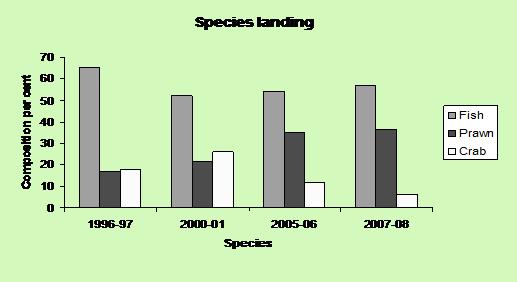
Prawns and crab are also major sources of lake-derived income for local fishermen. There are two major types of prawn species found in Chilika: penaeids and palemorids. Among the prawn species found in Chilika, the tiger prawns (Panaeus monodon) are in demand throughout the world. Prawns can also be grown by aquaculture and can be captured using a number of methods. Prawn captured by traditional methods have soft skins and they decay quickly, which exporters see as a disadvantage as they prefer thick and hard-shelled prawn as they resist natural processes of decay. This factor, along with the relatively short period that prawn require to mature, has contributed to increasing levels of prawn culture, which was introduced to the Chilika area during the 1980s and 1990s. The overall prawn catch has significantly increased in recent years because of the increase in prawn aquaculture developed around the lake (Fig).
Fish and crustaceans of Chilika are the principle source of livelihood for the local population. About 70% of the local population depends upon fishing as their only means of livelihood. Fisheries directly support a population of 127,000 people, while associated industries and marketing operations support at least another 50,000.
Fisheries in Chilika
Most of the households of the area are engaged mainly in fishing, and capturing fish is a common practice across the area.
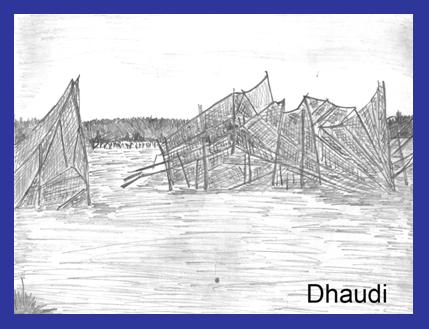
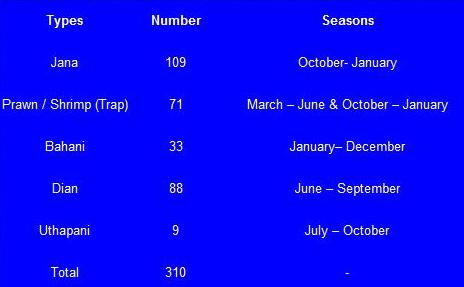
Chilika fishers operate five major types of fisheries (fishing techniques). These include Jana fisheries, Prawn fisheries, Bahani fisheries, Dian fisheries and Uthapani fisheries. There are 310 fisheries that operate in the lake applying these fishery techniques. The techniques that are applied vary by season ( Fig).